



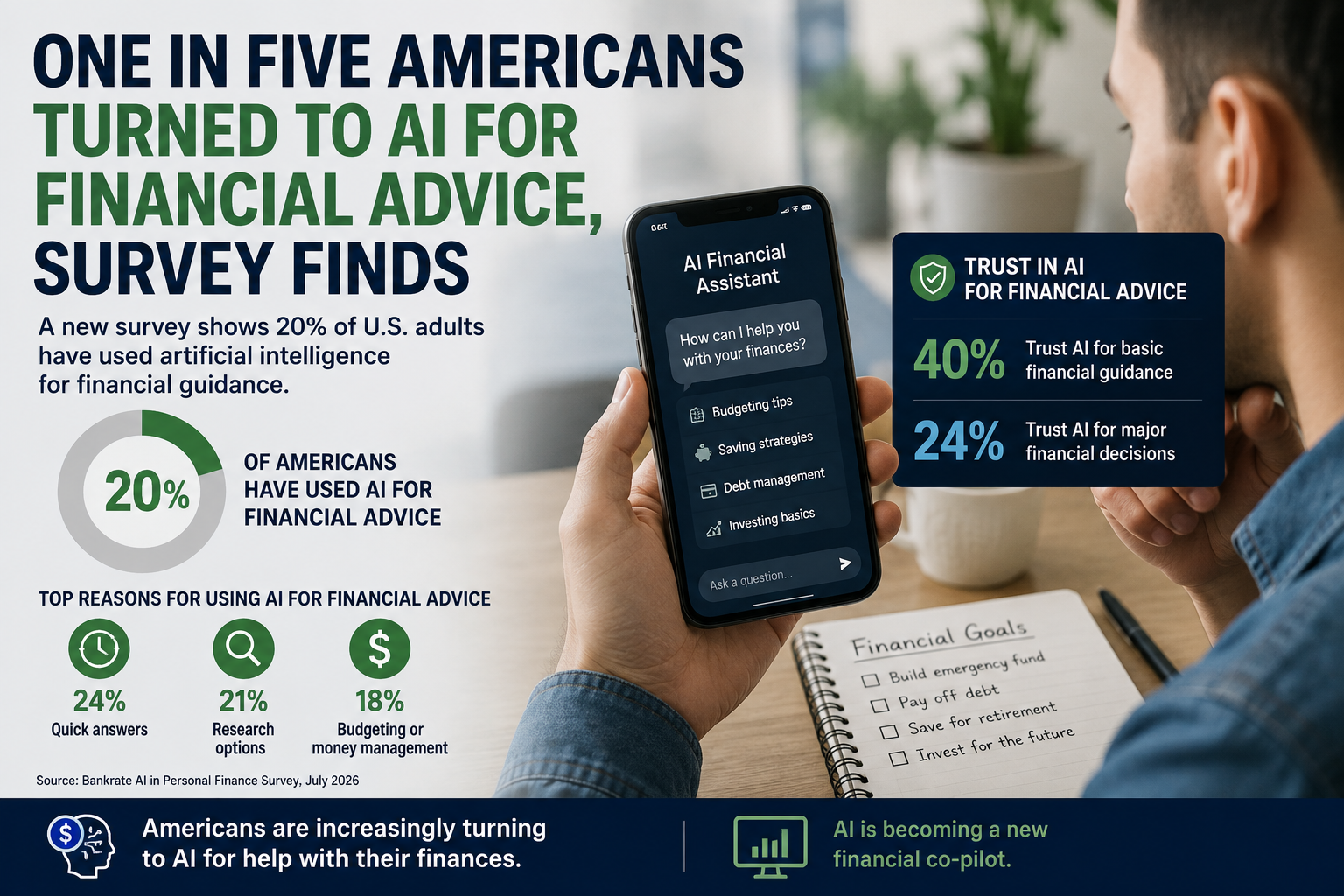
About one in five Americans who sought financial advice in the past year turned to artificial intelligence, even though few trust its expertise on money matters, according to a Gallup survey conducted in partnership with financial services firm Edward Jones.
Among U.S. adults overall, only about three in 10 said they have “a great deal” or “some” confidence in AI’s expertise for managing money, the survey found, including just 3% who trust it “a great deal.”
The poll, conducted in the spring among adults 21 and older, found a disconnect between the sources Americans say they trust for financial advice and the ones they actually use. About eight in 10 U.S. adults expressed at least some confidence in financial advisers, but only about a third of those who sought financial advice turned to a professional adviser. Far more, 73%, said they relied on their own internet research.
Financial experts say the gap reflects both cost and convenience. “I would encourage people to use AI to explain and define,” said Taha Choukhmane, an associate professor at MIT’s Sloan School of Management. “If you’re interested in knowing what the stock market is, what the difference between a mutual fund and an index fund is. Using AI to explain these concepts can be very useful because it can empower people to get the most out of these methods.” Choukhmane recommended using AI as a starting point in a broader research process rather than a sole source, and suggested asking AI tools to cite references that can be independently verified.
Most Americans sought financial guidance from at least one source in the past year, the survey found. Beyond internet research, financial advisers and AI, 35% turned to a parent, sibling or other relative, and 26% got information from news, media or social media. About two in 10 said they relied on a friend or an author, speaker or influencer, while fewer used an employer or retirement plan provider, a robo-adviser, or a teacher or professor.
Use of AI for financial guidance varies sharply by age. About a quarter of Generation Z and millennial adults who sought advice in the past year turned to AI, compared with 16% of Generation X and 7% of baby boomers. Reliance on professional advisers moved in the opposite direction: just 14% of Gen Z adults and 21% of millennials who sought guidance used a financial adviser, compared with 34% of Gen X adults and 55% of baby boomers. Cost may be a factor, since online research, AI tools and conversations with family or friends carry minimal expense compared with hiring a professional.
Because AI systems respond to the specific way a question is phrased, the guidance they produce can vary from user to user, experts noted. Some financial professionals also raised concerns about accountability: certified financial planners are legally obligated to provide advice suited to a client’s circumstances, while AI tools carry no such obligation, leaving the responsibility for decisions made on AI’s advice with the individual user.
The poll surveyed 5,075 U.S. adults age 21 and older from March 20 to April 6, 2026, using a sample drawn from Gallup’s probability-based panel, which is designed to be representative of the U.S. population. The margin of sampling error for U.S. adults overall is plus or minus 1.8 percentage points.
Turn on web search in Search and tools menu. Otherwise, links provided may not be accurate or up to date.