



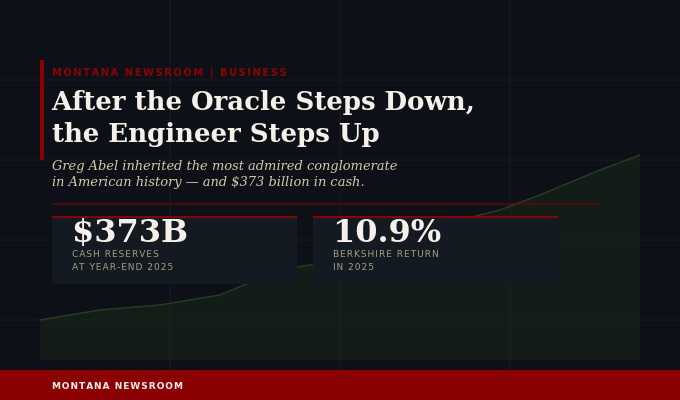
On January 1, 2026, Greg Abel walked into the most scrutinized corner office in corporate America. He did not inherit a struggling company in need of rescue, nor a turnaround story begging for a visionary. He inherited Berkshire Hathaway — the monument Warren Buffett spent six decades building from a failing New England textile mill into a $1 trillion colossus — and with it, a question that has haunted Wall Street for years: Can anyone follow the Oracle of Omaha?
The early returns suggest Abel, 63, is answering carefully and deliberately — very much in the style of the man who hand-picked him.
Buffett announced at Berkshire’s annual meeting in May 2025 that he would step down as CEO at year-end, recommending the board appoint Abel to the role. The next day, the board voted unanimously to confirm him, effective January 1, 2026, while retaining Buffett as chairman. The transition marked the first change in Berkshire Hathaway’s chief executive leadership since Buffett took control of the company in 1965.
The handoff was warm and public. Buffett called Abel “the decider” and told CNBC he would “rather have Greg handling my money than any of the top investment advisors or any of the top CEOs in the United States.” In his final shareholder letter, written in November, Buffett declared that Abel had “more than met the high expectations” he’d set for him.
An Engineer in a Philosopher’s Chair
Where Buffett spent decades cultivating an image as a folksy Midwestern sage — cherry Coke, See’s Candies, and pithy aphorisms at packed annual meetings — Abel is a different creature. Born in Edmonton, Alberta, Abel trained as an accountant and rose through the ranks of the energy sector, eventually running Berkshire Hathaway Energy with the operational discipline of a man who knows what a turbine costs and why it matters.
Before assuming the CEO role, he served as vice chairman of Berkshire Hathaway and oversaw the conglomerate’s non-insurance companies — the sprawling empire of railroads, utilities, manufacturers, and retailers that quietly generate billions in free cash flow every quarter.
His first shareholder letter, released in February, offered a window into his priorities. In the 20-page document, Abel praised Buffett’s guidance and leadership, expressed hope to grow Berkshire as CEO for the next 20 years, and committed to reinvesting for long-term growth and returning value to shareholders — delivering stability, he wrote, no matter who is at the helm.
The $373 Billion Question
No challenge looms larger for Abel than what to do with Berkshire’s extraordinary cash mountain. Abel took the helm as Berkshire sat on a record $381.6 billion in cash as of the end of September 2025, a pile that grew because Buffett — a net seller of stocks for 13 consecutive quarters — could not find companies or stocks he believed were priced fairly enough to buy.
Berkshire ended 2025 with $373.3 billion in combined cash and short-term investments and generated $25 billion in free cash flow for the year. That figure exceeds the market capitalization of 477 companies in the S&P 500. It is not a war chest so much as a small sovereign wealth fund.
In March, Abel made his first consequential move: Berkshire disclosed it had begun repurchasing its own shares on March 4, 2026 — the company’s first buybacks since May 2024, after a nearly two-year hiatus. Abel confirmed the decision in a CNBC interview, noting that he consulted with Buffett, who still serves as chairman, regarding the value and timing of the repurchases — a nod to the company’s policy requiring the CEO to consult with the board chairman before buying back stock.
Abel went further, putting his own money where his rhetoric is. He personally disclosed purchasing 21 Berkshire Class A shares for about $14.6 million — representing the after-tax value of his $25 million annual salary — and said he planned to make similar purchases in the future. In an interview with CNBC’s Becky Quick, he explained the reasoning plainly: “Absolute alignment with our shareholders, our partners, our owners is critical.”
Analysts took notice. Gabelli Funds portfolio manager Macrae Sykes called it “great to see more economic alignment with shareholders.” Keefe, Bruyette & Woods analyst Meyer Shields viewed both the resumed buybacks and Abel’s personal purchases as positives, though he noted ongoing earnings challenges at units like GEICO and Berkshire Hathaway Reinsurance.
Pruning the Portfolio
Abel is also beginning to reshape the investment portfolio — carefully, but unmistakably. In January, signals emerged that Berkshire was preparing to exit one of Buffett’s most famously troubled bets. Kraft Heinz disclosed in an SEC filing that Berkshire Hathaway may sell up to its entire 325-million-share stake, potentially ending a decade-long investment that Buffett himself had acknowledged as a mistake. The possible exit fits a pattern suggesting Abel may be more willing than his predecessor to recycle capital out of legacy, lower-conviction holdings.
Meanwhile, Abel has moved to extend Berkshire’s footprint in Japan, following a trail Buffett blazed. A Berkshire subsidiary announced a $1.8 billion investment to acquire a 2.5% stake in Tokio Marine, Japan’s leading non-life insurer, with the two companies agreeing to collaborate on global strategic investment opportunities, including mergers and acquisitions.
Continuity and Change
Berkshire shares slipped 1.4% on Abel’s first day as CEO — a muted vote of uncertainty from investors weighing whether Buffett’s successor could oversee the conglomerate’s vast empire with the same deft touch. But the stock had already delivered: Berkshire ended 2025 with a gain of 10.9%, notching its tenth consecutive year of positive returns.
Abel’s central message — to shareholders, to markets, to Berkshire’s 400,000 employees — has been one of deliberate continuity. He has pledged to preserve the company’s famously decentralized management model, its fortress balance sheet, and its culture of long-term thinking over quarterly optics.
Abel has disclosed that Buffett still comes into the office five days a week — a detail that speaks to both the elder statesman’s vitality and the transitional nature of this moment in Berkshire’s history. The chairman is still in the building. But the decisions belong to someone new.
Whether Abel proves to be the Tim Cook to Buffett’s Steve Jobs — one analyst has already drawn that parallel, predicting that by 2040, Berkshire shareholders will view Abel’s tenure with the same admiration that Apple shareholders hold for Cook’s record — remains an open question. What is clear is that the first quarter of the post-Buffett era has been marked not by drama, but by something far more Berkshire-appropriate: patient, methodical capital stewardship from a man who spent decades watching the master up close.
By: Montana Newsrooms staff