



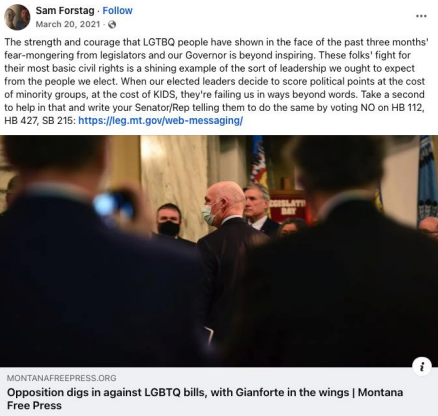
Democratic congressional nominee Sam Forstag’s past lobbying against a Montana law that barred biological males from competing in girls’ and women’s school sports is becoming an issue in the race for Montana’s western U.S. House seat following a major Supreme Court ruling.
Forstag worked for the ACLU of Montana during the 2021 legislative session, when the organization opposed House Bill 112, known as the Save Women’s Sports Act, and urged lawmakers to defeat it. The legislation required school athletic teams to be designated according to biological sex and prohibited biological males from competing on teams designated for girls and women.
The issue has gained renewed attention after the U.S. Supreme Court ruled 6-3 in June to uphold laws in Idaho and West Virginia that similarly reserve female athletic teams for biological females. The court held that sex-separated athletic teams are permitted under Title IX and rejected equal-protection challenges to the two states’ laws.
Republican congressional nominee Aaron Flint is pointing to the decision and Forstag’s lobbying history as a contrast between the candidates.
“The Supreme Court got it right,” Flint said. “This is a victory for common sense, for fairness, and for every young woman who has worked hard to compete on a level playing field.”
Flint accused Forstag of having “actively lobbied against Montana’s effort to protect girls’ sports,” pointing to Forstag’s work with the ACLU during the 2021 Legislature.
The ACLU of Montana made opposition to HB 112 one of its priorities that session. Its legislative materials listed the organization as opposing the measure and the group publicly urged lawmakers to reject it.
HB 112 ultimately passed the Republican-controlled Legislature and was signed into law by Republican Gov. Greg Gianforte.
Supporters argued the legislation was necessary to preserve competitive fairness and athletic opportunities for female athletes by ensuring that girls and women didn’t have to compete against biological males. Opponents, including the ACLU, argued that the law discriminated against transgender students by preventing transgender girls from participating on female teams.
The Supreme Court’s June ruling involved separate laws from Idaho and West Virginia rather than Montana’s statute, but the decision addressed the broader legal question surrounding states’ ability to maintain sex-separated athletic competition.
Justice Brett Kavanaugh, writing for the majority, concluded that Title IX allows schools to maintain separate men’s and women’s teams defined according to biological sex. The court also rejected the equal-protection challenges to the Idaho and West Virginia laws.
The ruling has brought renewed political attention to votes and lobbying surrounding similar legislation in other states, including Montana.
“Montanans deserve a representative who will protect girls’ sports, defend parental rights, and stand up for children,” Flint said, arguing that his position and Forstag’s record present voters with a clear contrast.
Forstag and the ACLU took the opposite position during the 2021 debate, arguing that excluding transgender girls from female athletic teams was discriminatory and harmful to transgender students.
Five years later, Forstag’s role in opposing Montana’s legislation is becoming part of the congressional campaign as voters consider the records and positions of the two candidates seeking to represent western Montana.
By: Montana Newsroom staff