



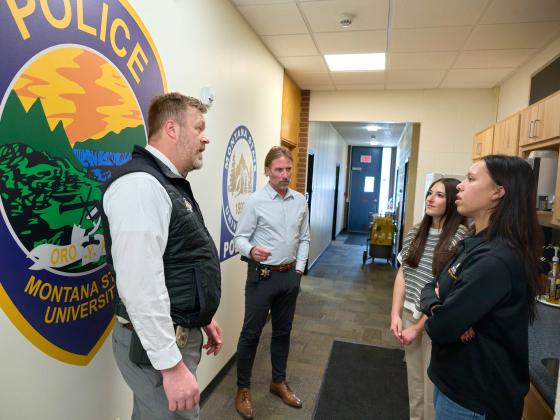
As the fourth largest state in the U.S. with the sixth smallest population, each agency relies on another for niche expertise, whereas bigger agencies can potentially accomplish everything on their own, said Adam Pankratz, deputy chief of Montana State University’s police department. These relationships start to form during basic training, which 14 future officers from across Montana will undergo this summer at Gallatin College MSU’s new Law Enforcement Academy.
Whether they are just starting their journey in law enforcement or are entry-level officers sponsored by Montana agencies, students will work alongside each other for more than 570 hours in pursuit of a Certificate of Applied Science in law enforcement before entering the field. The academy’s inaugural class starts on May 11.
“We’re sending these officers out there not just to be police officers, but to be active members of whatever community they join,” said Pankratz, who is also program coordinator for the academy. “In our profession, you don’t have to wear a rank insignia to be a leader. Every law enforcement officer is a leader within their community.”
Gallatin College MSU’s Law Enforcement Academy is only the second law enforcement training school in the state. The first is Helena’s Montana Law Enforcement Academy, which was previously housed at MSU from 1959 to 1976.
As the number of entry-level officers requiring basic training increases in Montana, so does the need for infrastructure to accommodate that growth, Pankratz said. In the last 10 years, Montana has added more than 400 new law enforcement officers, according to the Montana Board of Crime Control.
A statewide law enforcement advisory committee identified a two-year college setting as a practical option for additional training space and instruction, based on a national trend of academies becoming housed in such settings. The committee selected Gallatin College MSU to host the academy, which received $320,000 in federal funding this year for startup costs.
Students will spend 14 weeks in training, receiving instruction from active officers employed at MSU’s police department, the Bozeman Police Department and the Gallatin County Sheriff’s Office, among other Montana agency representatives and MSU faculty. The local agencies will host students for mock scenarios, firearms training and internships, though most classes will take place on the MSU campus.
“You want to make sure that the person behind you is going to be better than you were,” said Clint Harper, captain at the Gallatin County Sherrif’s Office who oversees the academy’s curriculum. “So that’s our goal: When we leave this profession, we leave it in good hands.”
That’s why students’ coursework will emphasize the value of public trust with Montana criminal code, ethics and communication, Pankratz said. Then, students will apply their knowledge in mock scenarios, such as responding to theft calls or domestic disputes. The scenarios will build in complexity, from a case-based discussion to an on-campus virtual simulator to acting out a scenario with volunteers.
Gabe Saunders, a newly hired deputy sheriff in Gallatin County, is looking forward to learning case law and investigation strategies from the individuals he will be working with in the future, especially since they helped design the program’s curriculum. Saunders, a 24-year-old from Bozeman, joined the sheriff’s office to serve his community after leaving the U.S. Marine Corps.
“This community was very good to me when I was growing up, and it would only be right to try to give back and better it in any way I can,” said Saunders, whose long-term career goals include joining the Missouri River Drug Task Force or Gallatin Valley SWAT team.
Jacob Gamnerdsiri, a 19-year-old from Henderson, Nevada, felt a similar pull to community service when joining the Law Enforcement Academy. His parents both work in the medical field and raised him to “be a good human,” he said. After graduating, he plans to work for a local agency while being a full-time student at MSU in mechanical engineering technology and pre-law, with the long-term goal of attending law school.
“When you’re in a position to help others, you do it,” Gamnerdsiri said. “I want to be part of something that’s bigger than me and create the relationships officers have with the community.”
Students like Gamnerdsiri, who are not already employed by a law enforcement agency, will intern for a Gallatin County department toward the end of their 14 weeks while taking their final classes online. They will also have opportunities to network and job search during a career fair. Entry-level officers will complete training at their home department in place of an internship.
Once students complete in-person courses on Aug. 7 and are hired in Montana, they will be eligible to pursue a state-recognized Public Officer Safety Training certification within five years. Certificates from Gallatin College MSU are applicable only to Montana agencies. In Bozeman, police officers often earn about $76,500 annually.
“Gallatin College is proud to support and train officers responsible for protecting and serving their communities across Montana,” said Stephanie Gray, dean of Gallatin College MSU.
By: