



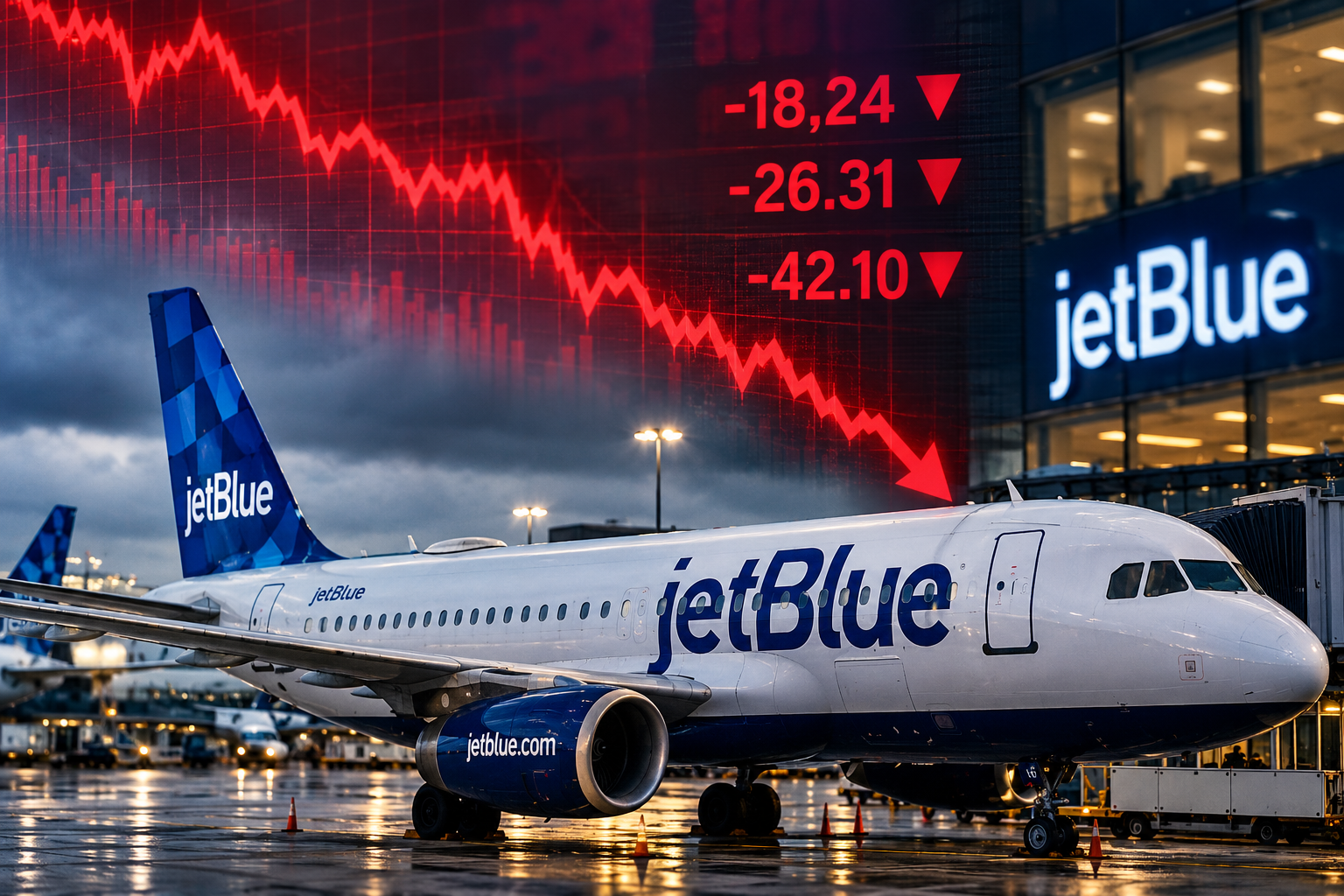
NEW YORK — JetBlue Airways is facing mounting financial pressure as a group of major creditors has hired restructuring advisers following a sharp decline in the airline’s stock and bond prices, raising concerns about its ability to manage billions of dollars in debt amid soaring fuel costs.
The creditor group, which includes investors holding approximately $2 billion in bonds due in 2031 and a $742 million first-lien loan, is working with financial advisory firm PJT Partners and law firm Akin Gump Strauss Hauer & Feld, according to people familiar with the arrangements.
The development comes ahead of JetBlue’s third-quarter earnings report Tuesday, Oct. 27, when investors are expected to closely examine the company’s cash position, operating losses and plans to address its substantial debt obligations.
JetBlue shares and debt securities fell to record lows during the past week as investors reacted to rising jet fuel costs and weakening financial forecasts across the airline industry.
The company’s $2 billion in bonds due in 2031, backed by collateral associated with JetBlue’s TrueBlue loyalty program, declined approximately 10 cents during the week to around 45 cents on the dollar, according to Bloomberg market data.
The $742 million first-lien loan experienced a similar decline, falling approximately 13 cents to 45 cents on the dollar.
Such steep discounts indicate significant investor concern about the company’s financial outlook and the potential recovery available to lenders if JetBlue cannot meet its obligations.
JetBlue shares also came under heavy selling pressure, reaching their lowest levels since the airline went public in 2002.
The appointment of financial and legal advisers allows creditors to coordinate their interests and evaluate potential options for protecting their investments.
However, hiring restructuring advisers does not necessarily mean a bankruptcy filing is imminent. Creditors frequently organize when companies experience financial stress, particularly when debt prices fall sharply.
JetBlue, PJT Partners and Akin Gump did not immediately respond to requests for comment on the reported arrangements.
The airline’s financial difficulties have intensified as higher fuel prices place additional pressure on operating expenses.
Several major U.S. carriers have recently lowered their financial outlooks, warning that elevated jet fuel costs could continue affecting profitability despite relatively strong passenger demand.
United Airlines Chief Executive Scott Kirby warned Wednesday that some competitors could face deeper financial difficulties following the collapse of budget carrier Spirit Airlines.
Although Kirby did not identify specific airlines, his comments added to investor concerns about financially weaker carriers.
JetBlue has struggled to return to consistent profitability while implementing a turnaround strategy intended to improve revenue, reduce costs and strengthen its competitive position.
The airline has been particularly vulnerable to higher operating expenses because of its concentration in competitive markets, including New York, Boston and Florida.
In June, S&P Global Ratings lowered JetBlue’s credit rating one notch to CCC+, reflecting concerns about persistent cash losses and increasing financial obligations.
The credit rating agency projected that JetBlue could experience a free cash flow deficit of approximately $1 billion in 2026 as higher fuel prices delay progress on its turnaround efforts.
S&P also warned that growing debt service obligations were adding pressure to the company’s already elevated cost structure.
At the end of June, JetBlue reported approximately $8.5 billion in total debt and finance lease obligations.
The airline also disclosed roughly $6 billion in unencumbered assets and approximately $2 billion in available cash and liquidity resources.
Those assets provide potential borrowing capacity, although additional financing could increase interest expenses and place further demands on future cash flow.
JetBlue has previously used aircraft and assets associated with its loyalty program to secure financing, a strategy that has helped raise capital but also limits the assets available to support future borrowing.
The airline has continued pursuing its JetForward restructuring strategy, which focuses on operational improvements, cost reductions and higher-margin revenue opportunities.
Management has also emphasized expanding premium services and strengthening its customer loyalty program as ways to improve profitability.
Despite those initiatives, rising fuel expenses and the company’s substantial debt burden have complicated its recovery.
JetBlue said in a September financial update that travel demand remained strong, but higher fuel prices and operational disruptions had increased its expected costs.
The company raised its projected third-quarter fuel expense to approximately $3.96 per gallon, compared with an earlier estimate of $3.49.
It also increased its outlook for nonfuel operating costs, citing weather-related disruptions and air traffic control constraints.
While stronger ticket pricing helped offset some of those expenses, investors remain concerned about JetBlue’s ability to generate sufficient cash to meet financial obligations and fund operations.
JetBlue is scheduled to discuss its third-quarter financial results Tuesday at 10 a.m. Eastern.